Eco-Friendly Chopping Boards for Outdoor Use: What Holds Up
Look at any list of eco-friendly cutting boards and the same three materials appear: bamboo, certified hardwood, and something described as recycled composite. The reasoning is easy to follow. Wood grows back, plastic comes out of an oil well, so wood must be the greener choice.
That reasoning holds right up to the moment you carry the board outside.
An outdoor board lives through things a kitchen board never sees: rain, direct sun, dew at four in the morning, a twenty-degree swing between noon and midnight, and a wash in a campsite sink with no hot water and nowhere to dry properly. Under those conditions the material that looked greenest on the shelf is often the first to fail, and a board that fails in two seasons is not an environmentally friendly choice no matter what it is made from.
What follows is an attempt to answer the question properly: what makes a cutting board eco-friendly for outdoor use, which materials survive it, and how to tell a real claim from a label.

Why the Most Natural Board Is Often the Least Sustainable Outdoors
The bamboo argument, and where it stops being useful
Ask for a sustainable wood cutting board and you will be shown bamboo, teak or acacia nine times out of ten. Bamboo earns that reputation honestly. It reaches harvestable size in three to five years, it regrows from the root without replanting, and most plantations need no pesticide. As a raw material, it is close to ideal, and if the question were only "which material grows back fastest" the answer would be settled.
Three things sit outside that question.
The first is that a bamboo board is not bamboo. It is bamboo strips bonded under pressure into a block, and the bond is the part that matters outdoors. A board built from dozens of strips has dozens of joints, and every joint is a route for water and the first place a bond will open when the board swells and shrinks. Solid hardwood avoids the glue lines but not the swelling.
The second is that certification answers a different question than the one being asked. FSC certification says something about how the forest was managed. It says nothing about whether the board will still be flat after a summer in a car boot, and lifespan is the single largest factor in whether any product is environmentally sound.
The third is transport. Bamboo and tropical hardwood come from a small number of producing regions. A board that grows quickly in one hemisphere and is sold in another carries freight, and freight scales with weight. A thick wooden block is the heaviest object in the camping kitchen box.
What water actually does to wood
Wood is a bundle of cells that were built to move water. That structure does not stop working when the tree is cut. A board takes on moisture, swells, and releases it as it dries, and the cycle repeats every time it rains. Repeated swelling and shrinking is what produces cupping, splitting along the grain, and separation at glue lines.
Once a crack opens, the failure accelerates. Water enters through the crack and leaves far more slowly than it entered, so the interior stays damp for days. This is also why wood is the one common board material you should not put through a dishwasher: the heat and the soaking speed up exactly the cycle that destroys it.
There is a widely cited set of studies from the University of Wisconsin in the 1990s showing that bacteria inoculated onto wooden boards died off faster than on plastic ones. The finding is real, and it gets quoted in almost every article arguing for wood. What tends to get dropped is the condition under which it was observed: the boards were cleaned and allowed to dry between uses. Dry wood is a hostile surface for bacteria. Wet wood is not, and a board left out through a rainy weekend stays wet inside long after the surface looks dry.
None of this is an argument against wood in a kitchen, where it has a controlled environment and someone to look after it. It is an argument against wood as the default answer for the outdoors. If you do want the full comparison for indoor use, we set out wooden against plastic cutting boards side by side here.
Four Questions That Decide Whether a Board Is Really Eco-Friendly
Most green claims on a cutting board come down to one variable: what the material is made from. That is the least useful of the four that matter, because it is the only one a supplier can improve without changing anything about the product's actual behaviour.
The four questions below are the ones worth putting to a supplier. The order matters, because lifespan outweighs everything else on the list: a board made from virgin polymer that lasts ten years beats a board made from reclaimed fibre that lasts two, on any measure that includes the energy and water used to make the replacement. Whether recyclable cutting boards are actually recycled, meanwhile, depends entirely on the local collection stream, which is why the fourth row asks where the board goes rather than what it is made from.
Swipe the table sideways for the full comparison.
| Question | Bamboo and hardwood | 100% recycled HDPE | Wheat straw PP composite | TPU and thin PP |
|---|---|---|---|---|
| Where the material comes from | Plantation or managed forest. Renewable, but requires glue, kiln drying and long freight. | Post-industrial and post-consumer HDPE, reprocessed into sheet. Displaces virgin resin one-for-one. | Polypropylene filled with wheat straw, an agricultural residue that would otherwise be burned or composted. | Virgin polymer. The environmental gain is not in the feedstock but in the mass, roughly a tenth of a wooden block of the same footprint. |
| How long it lasts outdoors | Two to four seasons if left exposed. Cracks, cups and splits, and cannot be repaired once split. | Years, not seasons. No grain to split. Fails by scratching and staining rather than structurally. | Similar to HDPE, with a stiffer, more matte surface. Fails by scratching rather than cracking. | Years of light use. A very thin sheet can crease if folded hard, and is not built for cleavers. |
| Maintenance it demands | Food-grade mineral oil every few weeks, full dry after every wash, no dishwasher, no soaking. | Rinse, wash, air dry. Dishwasher safe. No oil, ever. | Rinse, wash, air dry. Dishwasher safe. No oil, ever. | Rinse and hang. Rolls or folds into a pack, dries in minutes. |
| Where it goes at end of life | Landfill or fire. Glued boards cannot be cleanly composted and are not accepted in wood recycling. | HDPE is resin code 2, one of the most widely collected plastics. Can be reground and remoulded. | Resin code 5 stream, recyclable where PP is collected. Not biodegradable, despite what the straw content suggests. | Recyclable where the local stream accepts it. The small mass means a small waste problem either way. |
| Verdict for outdoor use | Works well as a serving board for an afternoon. Poor as a working surface that stays outside. | The strongest all-round answer for a base camp or a permanent outdoor kitchen. | The best balance if you want a board that looks like a natural material and behaves like polymer. | The only sensible option when the constraint is a rucksack. |
Read down the second row first. Lifespan is the row that decides the rest, and it is the row bamboo loses on outdoors.
How the Main Materials Actually Behave Outdoors
What follows is not a ranking. It is a description of how each material behaves under the conditions an eco friendly chopping board is actually asked to survive, which is a narrower and more useful question than which material is most natural.
Bamboo and hardwood
Bamboo is dense, hard and dimensionally more stable than most softwoods, which is why it performs acceptably in a kitchen. Outdoors the stability has limits. Bamboo absorbs water through its end grain faster than a sealed hardwood does, and a board left in the rain will show raised grain and a visible joint line within a season.
Hardwoods such as teak handle moisture better because of their natural oils, and that is a genuine advantage. It is also a temporary one. The oils migrate and oxidise, the surface goes grey, and the board needs oiling to keep the advantage it was bought for. A teak board that has been left outside for two summers without oil is a different object from the one that was sold.
Where both materials do earn a place outdoors is on the table rather than the prep surface: a board that holds bread, cheese and sliced meat for an hour and then goes back inside. That is a serving job, and wood is better at it than polymer. Treating a wooden board as a fixed outdoor surface is where the trouble starts.
100% recycled HDPE, and the detail that proves it
High-density polyethylene is the material most commercial kitchens already use, for reasons that have nothing to do with sustainability: it is dense, it does not absorb, it takes a knife mark without spitting, and it can be washed in water hot enough to sanitise it. Recycled HDPE keeps every one of those properties, because reprocessing changes the shape of the resin, not its chemistry.
What it adds is a property worth knowing about, because it is the one green claim on a cutting board that a buyer can check with their eyes.
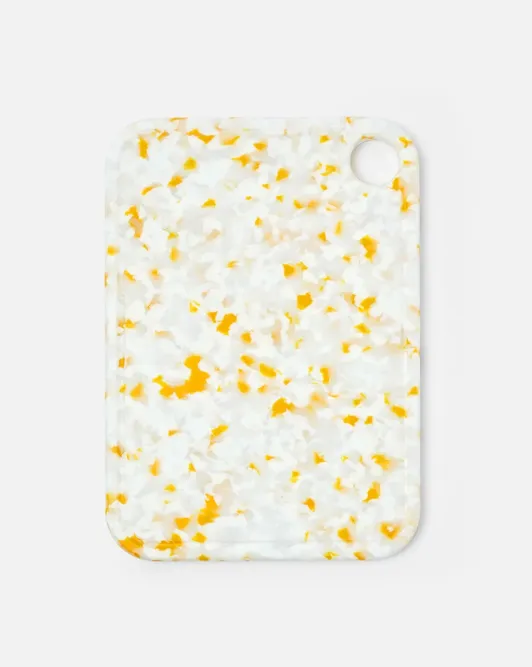
Recycled HDPE arrives as flake from mixed sources, and the flake keeps its colour. Melted and pressed, it produces the mottled surface in the photograph above: pale fragments, coloured fragments, and a pattern that cannot be repeated from one board to the next. A printed imitation is regular. A pigmented virgin sheet is uniform. An irregular speckle is what a genuinely reclaimed feedstock looks like, and it is the reason a recycled board is never quite the colour of the sample you approved.
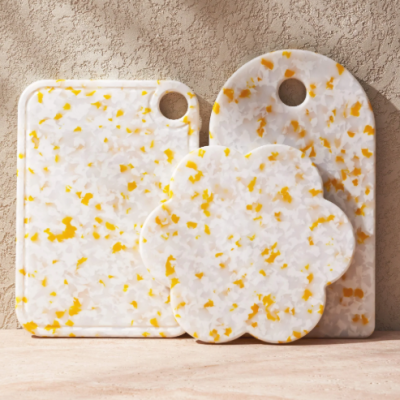
Our own recycled board, the Lemon Meringue, is made from 100% recycled HDPE and comes in three shapes at 2 cm thick, dishwasher safe and BPA-free. The full argument for the material, including what the recycling stream will and will not accept, is in our guide to recycled plastic cutting boards.
Two honest limits. Recycled HDPE is not food-safe by default; it is food-safe because the feedstock is controlled and the sheet is produced to a food-contact specification, and that is a claim a supplier has to be able to document. And colour consistency is genuinely worse than virgin material, which matters if you are buying pallet quantities for a retail programme and need every unit to match.
Wheat straw polypropylene
Wheat straw composite takes a different route to the same end. Instead of reclaiming finished plastic, it fills virgin polypropylene with wheat straw, the stalk left over after the grain is harvested. The residue is abundant, it is not a food crop, and the alternative disposal routes are burning or letting it rot in a field.
The filler does three useful things. It displaces a portion of the petrochemical resin, so less virgin polymer goes into each board. It stiffens the sheet, which gives a firmer cutting feel than unfilled polypropylene. And it gives the board a matte, faintly fibrous appearance that reads as a natural material, which is why the material sells.
It does one thing that gets oversold. Wheat straw composite is not biodegradable. The polymer matrix is still polypropylene, and a board buried in soil will be there in fifty years. A supplier who implies otherwise is either confused or hoping you are. Where the material does reduce impact is upstream, in the resin that did not have to be produced, and downstream, in a board that is recyclable in the PP stream. Boards in this material are covered in more detail in our piece on dishwasher-safe wheat straw boards.
Thin TPU and folding polypropylene
There is a version of this question where the greenest board is the one you barely notice carrying. TPU is a flexible polyurethane that can be produced as a sheet thin enough to roll, which changes the transport arithmetic completely: a 0.3 cm sheet at 28 by 18 cm uses a small fraction of the material in a 3 cm hardwood block of the same footprint, and weighs accordingly.
Flexible boards have a real limitation and it is worth stating plainly. They are not built for a cleaver. A thin sheet on a picnic table flexes under a heavy downward cut, and the edge goes through into the table. For vegetable prep, cheese, bread and fish, they are excellent. For splitting a chicken, use something rigid.
The middle option is a folding board in polypropylene with a TPE grip edge, around half a centimetre thick. It folds along a hinge into a chute, which is genuinely useful outdoors because it lets you slide prepped food into a pan without a second container. Our folding board is 39 by 22 cm at 0.5 cm and dishwasher safe. If folding is the feature you are after rather than weight, the camping folding board guide goes through the hinge and grip details that separate a good one from a novelty.
For the flexible end of the range, the TPU board explainer covers why the material resists deep scoring better than rigid polyethylene.
Stainless and titanium faces
A steel face is the one surface that cannot grow mould, because there is nothing in it to hold moisture. That makes it a defensible choice for raw meat outdoors, where the wash-up is often a bottle of water and a cloth. The trade-off is at the edge: steel gives a knife nowhere to deform into, so the edge dulls faster than on polymer. The mechanism and the workarounds are set out in our stainless steel board guide, and it is worth reading before you decide steel is the simple answer for outdoor protein prep.
Boards built for the outside, not adapted for it
Recycled HDPE, wheat straw composite, folding TPE and 0.3 cm TPU sheets, all dishwasher safe. Eight outdoor models in production, with colour, size and logo tooling available on OEM and ODM orders.
See the outdoor cutting board range →Factory direct · FDA and LFGB food-contact grade · OEM and ODM welcome
Six Outdoor Problems and How Each Material Answers Them
The challenges below are the ones that actually end a board's life outdoors. They are worth reading as a set, because most buying guides address only the first two and the last one is what kills more boards than either.
Swipe the table sideways for the full comparison.
| What happens outdoors | Bamboo and hardwood | Recycled HDPE and wheat straw PP | Thin TPU and folding PP |
|---|---|---|---|
| Rain, or a board left out overnight | Absorbs through end grain, swells, raises the grain, and dries slowly from the inside. Repeated cycles open glue lines. | Nothing enters. Water sits on the surface and runs off, and the board is dry within minutes of a wipe. | Nothing enters. A thin sheet drains and dries faster than any other option. |
| Direct sun and heat | Cups and checks as the outer face dries faster than the core. A warped board rocks and is unusable for precision work. | No grain direction, so no differential drying. A dark board gets hot to the touch but keeps its shape. | Stable. TPU softens slightly in extreme heat but returns to shape as it cools. |
| Damp storage between trips | The most common failure. A board packed away damp grows mould in the cracks, and the smell does not come out. | Cannot support mould growth on the surface, and a dishwasher cycle sanitises it completely. | Cannot support mould growth, and dries before it goes back in the bag. |
| Weight in a pack | A 3 cm hardwood block of the same footprint as a thin polymer sheet is roughly four to six times the mass, by volume and typical density alone. | Moderate. A 2 cm recycled board is a base-camp object, not a backpack one. | A 0.3 cm TPU sheet rolls up and adds almost nothing to pack weight. |
| Washing with no hot water | Cold water plus no drying time is the worst combination for wood. The board stays damp until you get home. | Wipes clean with cold water and soap, because nothing has gone below the surface. | Wipes clean and can be hung from a loop to dry in open air. |
| Being dropped, or used on rough ground | Splinters, chips at the corner, and a split that starts at the impact point. | Scuffs and dents. Cosmetic only, and no site for bacteria to colonise. | Bends rather than breaks. The most drop-tolerant material on the list. |
Note what the table does not say. Nothing here claims a polymer board is a better cutting surface than a good end-grain block in a kitchen, where the block has a dry home and someone to oil it. The claim is narrower: outdoors, the conditions that wood needs in order to perform are the conditions that are not available.
Weight, Pack Size and the Carbon You Never See
Every discussion of sustainable kitchen gear focuses on the material and skips the freight, which is a strange omission given that freight is measurable. A board that weighs almost nothing costs almost nothing to move. A board that weighs two kilograms costs two kilograms of fuel per unit, whether it travels by road, rail or air, and that cost is paid on every single unit rather than once.
This is the argument that makes thin boards defensible as an environmental choice rather than just a convenient one. A 0.3 cm TPU sheet at 28 by 18 cm contains a small fraction of the material in a 3 cm hardwood block of the same footprint, and the difference compounds across a container load.
Why the calculation is not as simple as it looks
Thin is not automatically better, and it is worth being precise about where the advantage stops.
A board that is too thin to use gets replaced, and a replaced board is worse than a heavy one that lasts. The useful question is not mass per unit but mass per year of service. A 0.3 cm sheet used twice a season for cheese and bread is efficient. The same sheet pressed into daily service splitting squash will fail, be replaced, and end up with a worse record than a thick recycled board that was bought once.
So the honest version of the rule is this: match the thickness to the job, and buy one board that fits the job rather than three that almost do. Carrying a 2 cm board to a trailhead and a 0.3 cm sheet to a base camp is not waste; carrying both everywhere is.
What pack size buys you beyond weight
A folding or rolling board also removes the need for a separate plate or prep tray, because it doubles as one. That substitution is easy to miss and it is usually the larger saving. One object that does two jobs beats two objects that each do one, in a pack and in a landfill.
If the constraint is genuinely a small pack, the compact outdoor board comparison covers the sizes that fit a daypack without being useless when you get there.
How to Spot an Eco Claim That Will Not Hold Up
The phrase environmentally friendly chopping board appears on more product pages in this category than any other claim, and a good deal of what sits behind it is either unverifiable or technically true and practically meaningless. The table below is not a list of dishonest claims. It is a list of claims that sound like more than they are.
Swipe the table sideways to read the third column.
| What the label says | What it can mean | What to ask instead |
|---|---|---|
| "BPA-free" | Almost always true and almost always irrelevant. Polypropylene and HDPE do not contain bisphenol A in the first place, so the claim distinguishes the product from nothing. | "Which resin is this, and what is the food-contact test report?" Resin identity tells you more than the absence of one additive. |
| "Biodegradable" | Meaningful for a certified compostable polymer, misleading for a filled polypropylene. Wheat straw filler does not make the PP matrix degrade. | "Degradable under which standard, in what environment, over what period?" If there is no standard named, there is no claim. |
| "Made from recycled material" | Could be 5% or 100%, post-industrial or post-consumer, and the difference matters for food contact. | "What percentage, and is there a third-party recycled-content declaration?" |
| "Natural antibacterial" | For wood, borrowed from studies run on clean dry boards. For plastic, a real additive but one that is regulated as a biocide. | "What is the active substance, and to which standard was it tested?" An effect without an active substance is a marketing line. |
| "Plastic-free" | On a board, means wood, bamboo or metal. None of the three solves the outdoor problems in the table above. | "How does it handle being left out in the rain?" This one question sorts most of the market. |
| "FSC-certified" | A genuine forest-management certification that says nothing about product lifespan or outdoor performance. | "How long is the board expected to last outdoors, and what is the warranty?" |
The one question that filters suppliers fastest
Ask what happens to the board at the end of its life, and listen to whether the answer is specific.
A supplier with a real position will tell you the resin code, whether the local collection stream accepts it, and whether they will take regrind back. A supplier without one will answer with the material it is made from, which is a different question, or with the word "recyclable" and no route attached. The difference between "it is recyclable" and "it goes in the number 2 stream, which is collected in most of Northern Europe and about half of the United States" is the difference between a claim and a fact.
The same test works in reverse when you are the one being asked. If a buyer asks what makes our boards environmentally preferable, the honest answer is the material substitution and the lifespan, not a certification badge.
Three boards for three kinds of outdoor cooking
A base camp, a daypack and a permanent outdoor kitchen are different problems. These are the three configurations that cover them without overlap.
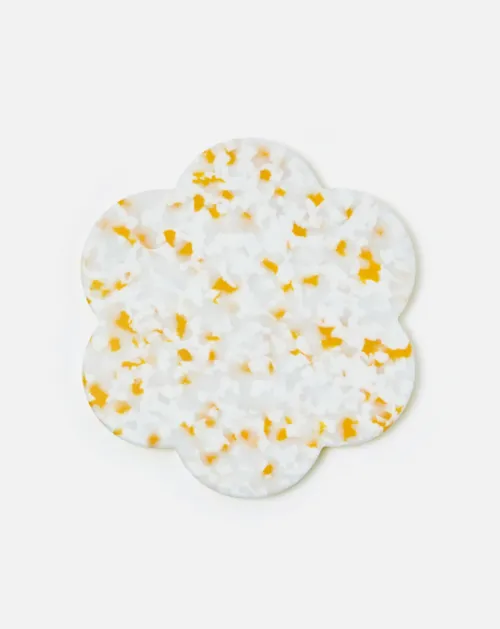 Base camp and outdoor kitchenRecycled HDPE board100% recycled HDPE, 2 cm thick, three shapes from 33 to 45 cm. Dishwasher safe, BPA-free, no oiling. The board that stays outside and does not care.View specs →
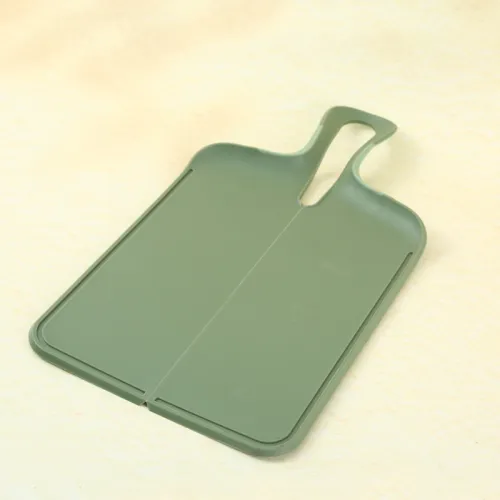 Car camping and tailgatingFolding TPE-grip board39 x 22 x 0.5 cm in polypropylene with a TPE grip edge. Folds on a central hinge into a chute for sliding prepped food straight into the pan.View specs →
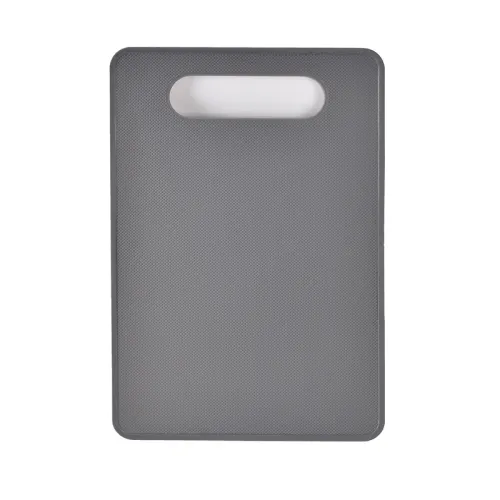 Hiking and cycle touringTPU mini sheet28 x 18 x 0.3 cm, flexible enough to roll, with a finger hole for hanging dry. Light enough that pack weight stops being a consideration.View specs →
Care That Keeps a Board Out of Landfill
The most sustainable board is the one you do not replace. That sentence is a cliche in sustainability writing and it is also the single most useful piece of advice on this page, because the gap between a board that lasts three years and one that lasts ten is almost entirely maintenance.
The thirty-second routine
Wash with hot water and washing-up liquid, rinse, and stand it on edge to dry. That is the whole routine. A polymer board does not need oil, does not need a food-safe wax, and does not need to be dried with a cloth. Standing it on edge matters only because water pooling on a flat surface overnight leaves a mineral ring, which is cosmetic and annoying rather than harmful.
What actually shortens a board's life
Three things, in order of how much damage they do.
Deep scoring from a cleaver. Grooves that a fingernail catches are a hygiene problem rather than a structural one, and they are the reason commercial kitchens retire boards on a schedule. Use a separate board, or a thick one, for heavy chopping.
Bleach and abrasive pads. A dilute bleach solution is fine occasionally for sanitising; leaving a board soaking in it degrades the surface and dulls the colour. Steel wool takes the surface off along with the stain.
Storing it wet and flat. The commonest mistake with outdoor boards. A board packed away damp in a dry bag will come out smelling of the inside of the bag, and the smell is in the surface layer.
When a board does need to go, the decision point is scoring depth rather than age. Our guide to when to replace a plastic cutting board sets out the test. And if the board has simply gone stained rather than scored, the wheat straw care guide covers what will and will not lift out of a filled composite surface.
Frequently Asked Questions
What does an eco chopping board actually mean?
The phrase is used for at least three different things and they are not interchangeable. It can describe a board made from a renewable material, a board made from reclaimed material, or simply a board with a green box and a leaf on the label. The first two are measurable and the third is not. When you see the term eco board on a product page, the useful follow-up is which of the three it refers to, and a supplier who answers without hesitating is worth talking to. The same goes for eco cutting board: the word is doing a great deal of work in that sentence, and it is fair to ask it to mean something specific.
Are bamboo cutting boards eco-friendly?
As a raw material, yes: bamboo regrows quickly and needs little input. As a finished board used outdoors, the answer is weaker than the material suggests. Bamboo boards are strips bonded into a block, which leaves many joints for water to enter, and a board that cracks within two seasons is replaced more often than a longer-lasting alternative. For indoor use with proper drying, bamboo is a reasonable choice. For a board that lives outside, it is not.
Can wooden cutting boards go in the dishwasher?
No. Heat and prolonged soaking accelerate the swelling and shrinking that splits wood and opens glue lines, and most manufacturers exclude dishwasher use from their warranty for exactly that reason. A wooden board should be hand-washed, dried immediately and oiled periodically. A polypropylene, HDPE or TPU board can go through a dishwasher on a normal cycle.
Are plastic cutting boards recyclable?
The two resins used for most boards are among the more recyclable plastics. HDPE is resin code 2 and polypropylene is code 5, and both are collected in many municipal programmes, though local acceptance varies more than the labels suggest. What matters more than recyclability is lifespan: a board in service for ten years has already avoided nine replacements, which outweighs the recycling question.
Is wheat straw plastic biodegradable?
No. Wheat straw composite is polypropylene filled with straw fibre. The filler is a renewable agricultural residue, which reduces the amount of virgin resin in the board, but the polymer matrix does not break down in soil or in landfill. Any claim of biodegradability for this material should be treated with suspicion unless a specific standard and timeframe are named.
What is the most eco-friendly cutting board for camping?
It depends on how you are travelling. On foot or by bike, a thin TPU or folding polypropylene sheet wins, because the material saving and the freight saving both come from mass, and there is no board to oil or dry. For a base camp or a vehicle, a recycled HDPE board is the better answer: it survives being left out, needs no maintenance, and is recyclable at end of life.
Do plastic cutting boards need oiling?
No. Polypropylene, HDPE and TPU are non-porous and do not benefit from oil. Oil sits on the surface, attracts dust and eventually turns sticky. Oiling is a requirement of wood, and applying it to polymer is one of the more common bits of mistaken advice passed around camping forums.
Is recycled plastic safe for food contact?
It can be, and it is not automatically. Food safety depends on where the feedstock came from and whether the finished sheet was produced to a food-contact specification with the migration testing that goes with it. Post-industrial scrap from a known source is straightforward. Mixed post-consumer waste requires a controlled process. Ask a supplier for the resin identification and the food-contact report rather than taking the word "recycled" as a safety claim.
Why do recycled boards have a speckled pattern?
Because the feedstock arrives in mixed colours and the fragments keep their colour through reprocessing. The result is an irregular speckle that cannot be reproduced exactly from one batch to the next. A uniform sheet is either virgin material or a print, and the irregularity is the visible evidence that the recycled content is real.