Stainless Steel Cutting Board: Safe? 7 Pros and 5 Cons
Stainless Steel Cutting Boards: The Short Answer
Yes. A cutting board made from 304 or 316 food-grade stainless steel is one of the safest surfaces you can put a knife to, and it is the only common board material that will not absorb anything at all. Blood, marinade, fish juice and beetroot all stay on the surface, where soap and a sanitiser can reach them.
The cost is your knife edge. Steel gives nothing back when the blade lands, so edges wear faster than they do on wood or soft plastic. Everything below is about those two facts, plus the one specification almost nobody checks before buying: how thick the board actually is.
The 7 Pros and 5 Cons, at a Glance
Swipe the table sideways for the full comparison.
| Seven reasons to buy one | Five reasons not to |
|---|---|
| 1. Nothing soaks in. No juice, blood or marinade gets below the surface. | 1. It is hard on knife edges. Expect to hone more often. |
| 2. It sanitises in under a minute. Wash, wipe, done, so you can move from chicken to salad. | 2. It is loud. The clack of steel on steel carries through an open kitchen. |
| 3. It will not warp, crack or splinter. Wet or dry, hot or cold. | 3. Wet protein slides. A raw fillet can skate unless the board grips. |
| 4. No smell, no staining. Garlic, fish and turmeric wipe off. | 4. Weight and storage. Heavier than the same size in plastic, awkward to stand up. |
| 5. No microplastics. On a steel-only board there is no polymer to shed. | 5. Upfront cost, and it shows scratches. More to buy, and the finish marks over time. |
| 6. Dishwasher and heat safe. It can take a hot cycle and hold a hot pan. | |
| 7. Fully recyclable, and it outlasts the kitchen it was bought for. |
The 7 Pros, in Detail
1 Nothing soaks in
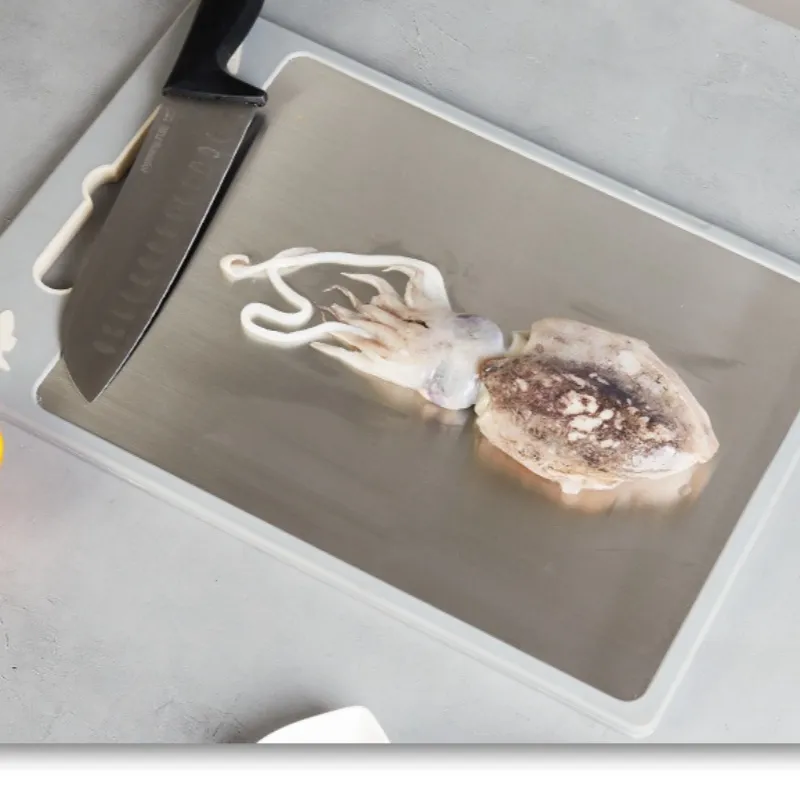
This is the whole argument, and everything else follows from it. Wood, bamboo and polyethylene are all porous to some degree. Put a raw chicken thigh on them and juice goes below the surface within minutes; on a grooved board it goes into the grooves. Stainless steel has no pores to enter. The liquid sits on top as a film, and a cloth takes it off.
What that means in practice: the surface you clean is the same surface that touched the food. There is no reservoir underneath.
2 It sanitises in under a minute
A steel board goes from "held raw chicken" to "safe for salad" in about the time it takes to wash your hands: hot water, soap, a wipe with a food-safe sanitiser, dry. No brush, no scrubbing into corners, no wondering whether you got all of it.
Compare that with a plastic board that has been in use for a year. Every knife mark is a place a brush has to reach, and most people do not reach all of them. The steel board has no such places.
3 It will not warp, crack or splinter
Wood swells and cups when it takes on water. Bamboo splits along the glue lines. Plastic bows in a hot dishwasher and never quite flattens again. Steel does none of these things, because there is no moisture to absorb and no grain to separate.
One honest exception, covered in full further down: a very thin steel sheet will flex under load. That is a thickness problem, not a material problem, and it is the single most useful thing to check before you buy.
4 No smell, no staining
The sulphur compounds in fish and garlic bind to porous surfaces and stay there. On steel they have nothing to bind to, so a rinse takes the smell with it. The same goes for colour: beetroot, turmeric and tomato sauce leave a steel board looking exactly as it did before.
If your current board smells of last night's salmon even after washing, that smell is in the material, and no amount of scrubbing will get all of it out.
5 No microplastics
Every plastic board sheds. Knife contact abrades the surface, and the fragments go into your food, your sink and eventually the water supply. A steel-only board has no polymer surface, so there is nothing to shed.
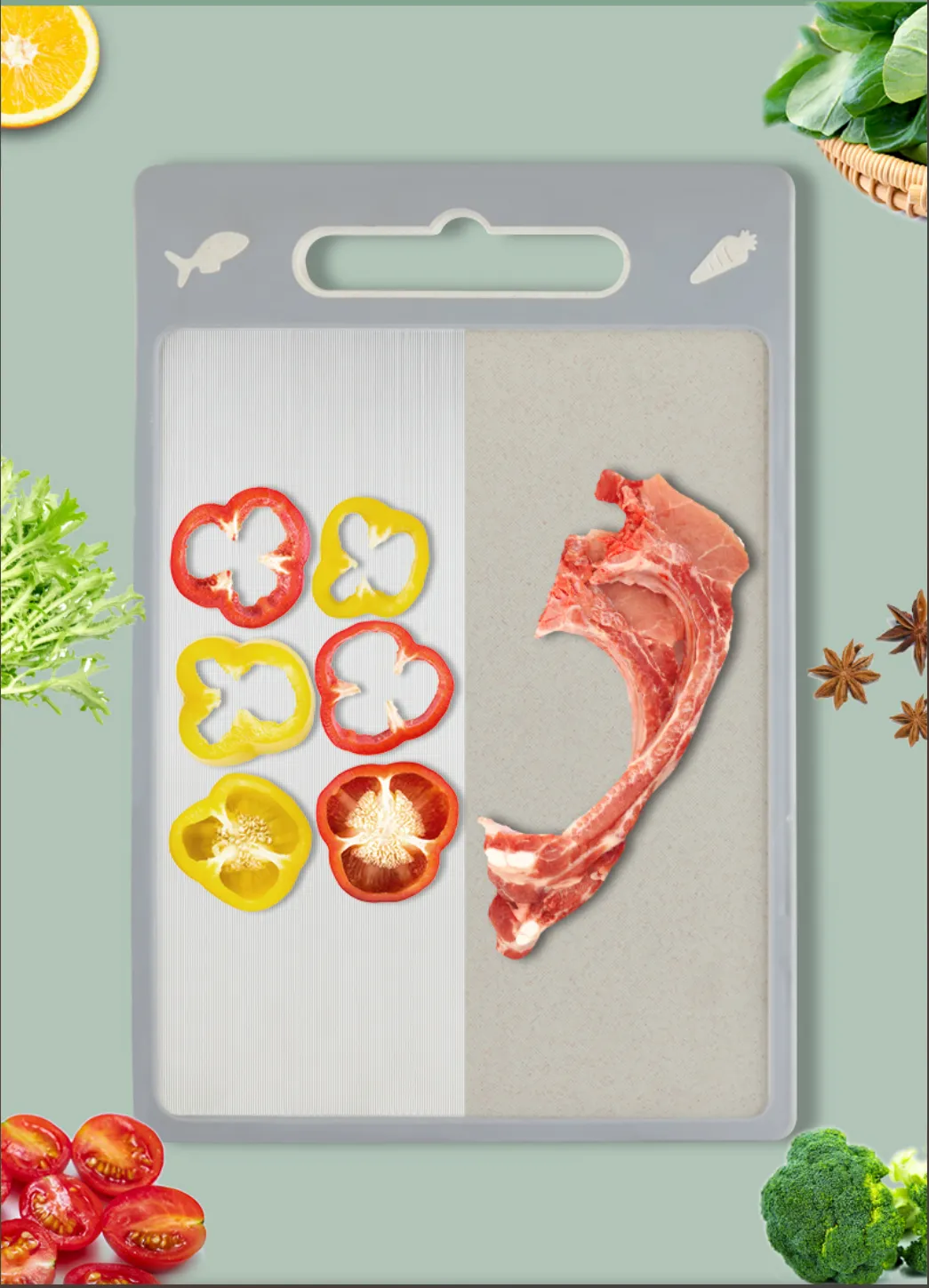
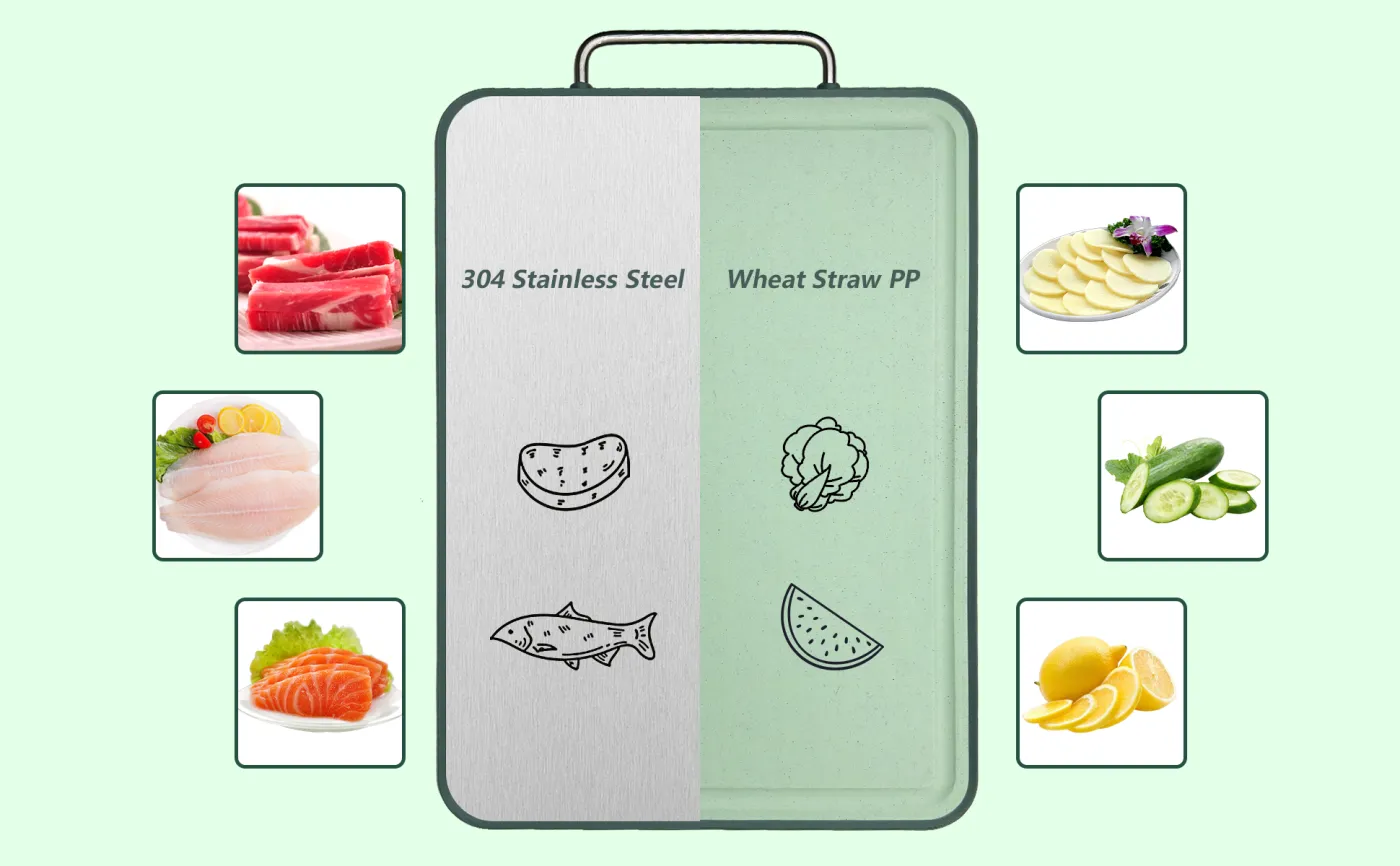
Be precise about this one, though. A double-sided board with a steel face and a wheat-straw polymer face, like the ones in our range, still has one face that can groove over years of use. The steel side is microplastic-free. The polymer side is a much better polymer than a cheap board, but it is still a polymer.
6 Dishwasher and heat safe
Solid steel takes a hot cycle, high-temp detergent and steam drying without any change. It also takes heat directly, which is why a steel board doubles as a landing place for a hot pan or a tray out of the oven.
The one thing to avoid is thermal shock on the counter underneath. A board straight off a hob will mark quartz or laminate, so set it on a trivet rather than straight down.
7 Recyclable, and it outlasts the kitchen
Stainless steel is one of the few kitchen materials with a genuine end-of-life route: it goes to scrap and comes back as new steel. That is a very different claim from "recyclable" printed on a plastic board that will realistically go to landfill.
The practical version is simpler. A steel board does not have a replacement cycle. You buy it once, and the reason you eventually stop using it will be that you moved house, not that it failed.
The 5 Cons and Disadvantages, in Detail
These are the stainless steel chopping board disadvantages you will actually notice, in the order most people notice them. If you have read a list of metal cutting board disadvantages somewhere else and wondered which of them are deal-breakers, this is the honest version: four of the five are manageable, and one is a genuine trade-off you cannot design away.
1 It is hard on knife edges
This is the real trade-off and it deserves an accurate explanation, because most articles get the reason wrong. They say steel is "harder than your knife". It usually is not. A 304 board runs around 70 on the Rockwell B scale, which is roughly 20 on the C scale. A decent chef's knife sits at 58 to 60 on the C scale. The blade is far harder than the board.
The problem is not hardness. It is that steel does not move. Wood and soft plastic deform slightly under the edge, which spreads the load over a fraction of a millimetre and lets the apex sink in. Steel refuses. Every chop lands as a hard impact, and a thin edge at 15 degrees per side does not enjoy hard impacts. It micro-chips. It rolls. It goes from shaving to dragging sooner than it would on wood.
You are not ruining the knife. You are shortening the interval between sharpenings, and how much depends on the steel in the blade and how you cut.
2 It is loud
Steel transmits sound rather than damping it. A cleaver on a steel board in a quiet kitchen is genuinely startling the first time, and in an open-plan home it is the complaint people mention most after the knives. If you cook late, or your kitchen shares a wall with a bedroom, this matters more than the spec sheet suggests.
A thicker board with a polymer body underneath is noticeably quieter than a thin sheet, because the polymer absorbs some of the ring.
3 Wet protein slides
Non-porous and slippery are the same property seen from two sides. The surface that refuses to absorb a chicken's juices also gives those juices nowhere to go, so a wet fillet can skate while you try to portion it.
Two fixes work. Put a damp towel or a silicone mat under the board so the board itself cannot move, and pat the protein dry before it goes down. A brushed or lightly textured face helps a little; a mirror-polished one is the worst case.
4 Weight and storage
A 40 x 28 cm board a couple of centimetres thick is heavy enough that lifting it one-handed while greasy is awkward, and it does not stack. If your storage is a drawer, check the size before you order. If it is a wall or a vertical rack, a steel board is actually easier to store than most wooden ones, because it is thin and it does not need to breathe.
5 Upfront cost, and it shows scratches
You will pay more at the till than for a plastic board. Over a few years that usually reverses, because the plastic board gets replaced and the steel one does not, but the first invoice is the one people remember.
On appearance: a brushed finish hides day-to-day knife marks well. A polished mirror finish shows every one of them within a month. Neither affects hygiene, and both are cosmetic, but if a scratched board would bother you, choose brushed.
Are Stainless Steel Cutting Boards Safe?
Three separate questions hide inside that one, and they have three different answers.
Food safety: what non-porous actually means
Bacteria need somewhere to sit. On a porous board they sit below the surface, inside grooves, and in the grain, where a cloth cannot reach. On steel they sit on the surface, where a sanitiser does reach.
That is the entire mechanism. It is not that steel kills bacteria. It is that steel gives bacteria nowhere to hide, and the cleaning you already do therefore works.
Chemical safety: 304, 316, or an unmarked mystery
Food-grade stainless is an alloy of iron, chromium and nickel. The chromium forms a passive oxide layer that stops rust and stops the metal reacting with food. Acid, salt and spice do not touch it.
304 is the standard for kitchen equipment and is the right grade for almost every home and commercial board. 316 adds molybdenum, which raises resistance to chlorides, and is the grade to specify if the board will live in a marine environment, a fish-processing line or regular heavy salt. Both are food-safe. What is not safe is an unmarked sheet bought on price, where "stainless" may mean a lower-chromium grade that spots, pits and eventually rusts.
The check is simple: ask for the grade in writing, and ask for the food-contact test report. Not the marketing claim, the report. This is the same discipline covered in our guide to what makes a cutting board food-safe.
The real risk is not the steel. It is the other face
Here is the failure that actually happens in home kitchens with a double-sided board. Someone portions chicken on the steel, flips the board, chops salad on the polymer face, and puts it away. The steel side was fine. The polymer side now has chicken juice on it, and it will be used for something raw again tomorrow.
Non-porous does not mean self-cleaning, and flipping is not the same as washing. Either wash between proteins and produce, or dedicate one face to raw and never swap. Whichever you choose, be consistent, because consistency is what stops cross-contamination.
Stainless Steel vs Wood, Plastic, Bamboo and Glass
Every "are stainless steel cutting boards better than X" question comes down to this table.
Swipe the table sideways for the full comparison.
| Material | Hygiene | Knife edge | Noise | Upkeep | Best for |
|---|---|---|---|---|---|
| Stainless steel | Best. Non-porous, sanitises in seconds. | Worst of the five. Hard contact, no give. | Loud | Wash and dry. No oiling. | Raw meat, fish, seafood, high-hygiene prep |
| Wood (maple, walnut) | Good if maintained. Porous, needs oiling and drying. | Best. Yields under the edge. | Quiet | Oil monthly, never soak, dry flat | Vegetables, herbs, bread, long prep sessions |
| Plastic / HDPE | Good when new. Grooves degrade it and shed. | Good. Slight give. | Quiet | Replace once grooved | Budget, colour-coded commercial systems |
| Bamboo | Fair. Glue lines and pores both absorb. | Fair. Harder than people expect. | Quiet | Oil, never soak, replace when it splits | Light home use, serving |
| Tempered glass | Excellent. Fully non-porous. | Very bad. Hard and brittle. | Very loud | Wipe only | Serving and cheese. Not cutting. |
Two of these comparisons get asked often enough to spell out. On wood, the longer version is in our wooden versus plastic cutting board guide. On glass, the short version is that glass is hard, brittle and completely unyielding, which is the worst combination of properties for a knife edge. Our PP versus glass comparison covers that in detail.
Will a Stainless Board Ruin Your Knives?
No. It will make you sharpen more often, which is not the same thing. Here is what actually happens to the edge.
Why the edge wears faster
Three things, in order of how much they matter.
- Impact instead of yield. There is no give under the blade, so the apex takes the full force of every chop. That is what produces micro-chips and a rolled edge.
- Lateral load. If you rock or twist the blade while it is in contact, a hard surface concentrates that sideways force right at the edge. On a soft board the surface deforms and forgives it.
- Scraping. Dragging the edge across the board to move chopped food is the single most destructive habit on any surface, and the least forgiving on steel.
Which knives cope, and which do not
Blade geometry matters more than brand. Thicker grinds with more metal behind the edge survive hard surfaces; thin, acute, high-hardness Japanese blades do not enjoy them at all.
- Copes well: German-pattern chef's knives around 56 to 58 HRC, cleavers, boning and utility knives, thicker blades, anything you already sharpen regularly.
- Struggles: very thin Japanese gyuto and petty knives at 61 HRC and above, single-bevel blades, anything with a 10 to 12 degree edge angle.
If you own the second group, keep them off steel entirely. A steel board is for the knives you use hard, not the ones you baby.
Technique that halves the wear
- Slice, do not chop. A draw stroke keeps the edge moving along its length instead of driving straight into a wall.
- Do not twist. Never use the blade to pry, lever or separate a joint on any board, and least of all on steel.
- Scrape with the spine. Turn the knife over, or use a bench scraper. This one habit is worth more than any board upgrade.
- Hone every few uses. A steel or ceramic rod realigns a rolled edge in twenty seconds. Honing is not sharpening, and it postpones the day you actually need to sharpen.
Test it on your own knife before you commit
Every con above is a specification you can work around, except the edge wear, and that one you should judge for yourself. We send samples so you can put your own knife on our steel for a week.
Request a stainless board sample →Factory direct · FDA and LFGB food-contact grade · OEM and ODM welcome
Thickness Is the Specification Nobody Checks
"Are stainless steel cutting boards sturdy?" is really a question about millimetres, and the answer ranges from "it flexes in your hand" to "you could stand on it". Three builds cover almost everything on the market.
Swipe the table sideways for the full comparison.
| Build | Thickness | How it behaves | Choose it if |
|---|---|---|---|
| Bare steel sheet | About 1 mm | Light, and it will flex if you press hard or lift it by one corner. Loudest of the three. | You want a hygienic prep mat to lift on and off, or a commercial line where boards are swapped constantly. |
| Steel and polymer composite | 1.1 to 1.2 cm | Rigid in normal use, noticeably quieter than a sheet, and double-sided by construction. | You want one board that does raw and produce, and you want it to sit still. |
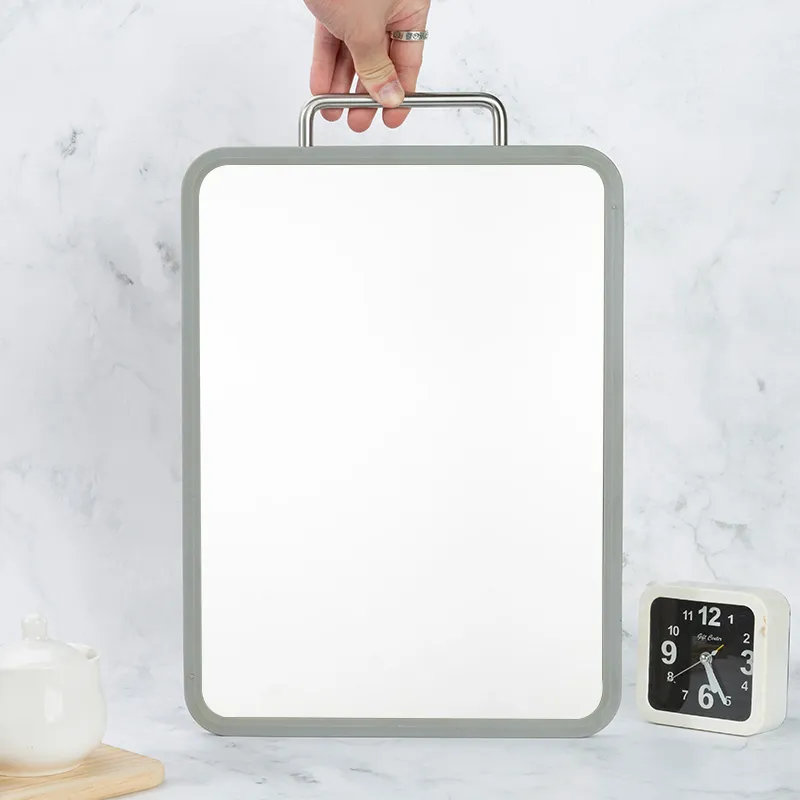
| Heavy composite with a carry handle | 2.4 to 3 cm | The most stable, the quietest of the three, and the heaviest to lift and store. | You break down whole birds and larger cuts, or you want the board to feel substantial. |
A 1 mm board that bows is not defective. It is a 1 mm board doing what a 1 mm board does, and it is the wrong product if you wanted mass under the cleaver. Ask for the number before you order, not after.
What Home Cooks and Commercial Kitchens Actually Say
Threads about stainless boards on cooking forums follow a fairly predictable pattern, and the pattern is more useful than any single comment.
- The people who keep using them bought them for raw meat. Almost every long-term user describes the board as a protein station rather than an everyday surface. That matches how the material behaves.
- The people who stopped mention knives. Edge wear is the most common reason a steel board ends up at the back of a cupboard. Noise is second.
- The "it is antibacterial" line gets corrected, every time. Someone with a metallurgy or food-safety background points out that stainless steel is not antimicrobial in any meaningful sense. It is non-porous, which is a different and more useful property, and it is why the board is easy to clean. Treat any product page that leans on "antibacterial steel" as a sign the seller is improvising.
- Commercial kitchens are less conflicted. Where boards are washed and swapped by rota several times an hour, hygiene wins outright and nobody is counting knife life in the same way.
Care: The Part That Actually Matters
After every use
Warm water, a drop of washing-up liquid, a soft sponge, rinse, dry. After raw meat or fish, follow with a food-safe sanitiser at the dilution on its label, let it sit for the stated contact time, then rinse and dry. The contact time is the part people skip, and it is the part that does the work.
Rust spots, hard water and discolouration
Genuine 304 or 316 should not rust in normal kitchen use. If small spots appear, they usually come from one of three things: the board sat wet, it was cleaned with steel wool or a chlorinated cleaner, or it was never actually food-grade steel to begin with.
For light spotting, a paste of bicarbonate of soda and water, rubbed gently with a soft cloth, then rinsed and dried. For hard-water film, white vinegar, a minute of contact, then rinse. If spots keep returning in the same place after that, the grade is the problem, not the care routine.
What the dishwasher actually does
Solid steel: nothing. It comes out unchanged. Composites depend on how the two faces are joined, so the question to ask before buying is whether the steel is set into the moulded body or glued to it. Moulded is the one that survives years of hot cycles.
Two habits make a difference either way. Rinse heavy debris first, and load the board so it cannot be struck by other items during the cycle.
Who Should Buy One, and Who Should Not
Buy one if you:
- Prep raw meat, poultry or fish several times a week and want a surface you can trust in ten seconds.
- Cook in a small kitchen where one board has to do several jobs, and washing between them has to be fast.
- Are replacing a plastic board that has gone grey, grooved or smelly, and you are tired of the replacement cycle.
- Want a board that can take a hot pan, a dishwasher cycle and a scrubbing brush without complaint.
Skip it if you:
- Own thin, high-hardness Japanese knives and care about keeping them at their best.
- Chop quietly, late, in an open-plan home and know the noise would bother you.
- Do mostly vegetables, herbs and bread, where a wooden board is both gentler and more pleasant.
- Want a board that doubles as a serving platter for cheese or charcuterie. Steel photographs badly and looks industrial on a table.
The setup most kitchens end up with is two boards rather than one, and it is worth saying plainly: steel for raw protein, wood or a quality polymer for everything else. That is not a compromise, it is the correct allocation of two materials to the two jobs they each do best.
How Chopaid Builds a Stainless Board
We mould cutting boards in Wenling, Zhejiang, and stainless is the range where the details are least forgiving, because a board that is wrong is wrong in ways a buyer notices on day one. A few specifics, so you can compare them against anything else you are looking at.
Steel and construction
SUS 304 as standard, with 316 available on request for salt-heavy or marine use. Edges are deburred and radiused, which sounds trivial until you have handled a board that was not. The steel face and the polymer body are fixed together during moulding rather than assembled afterwards; if the joint detail matters to your line, ask for the construction drawing rather than taking any supplier's marketing page for it.
The polymer face, and where the antibacterial claim actually lives
Our double-sided boards pair the steel face with a wheat-straw polypropylene face. That face carries a shell-derived additive that the factory tests to 99.9% antibacterial efficacy, and it is the reason the board can be sold as antibacterial at all.
It is worth being exact here, because a lot of listings are not. The steel face is not antibacterial. Steel is non-porous, which makes it easy to sanitise completely, and that is a real and useful property, but it is not the same claim. If a supplier tells you their stainless steel kills bacteria, ask for the test method and watch what happens next.
Sizes and formats in the current range
- 40 x 28 x 1.1 cm steel and wheat-straw composite, embossed non-slip back, stainless carry handle.
- 40 x 28 x 1.2 cm the same format in four colourways, so raw and cooked can be separated by colour as well as by face.
- 40 x 28 x 2.4 cm heavier build with a solid stainless handle and a full wrap-around non-slip edge.
All three are FDA and LFGB food-contact grade, and the plant runs to ISO 9001 and BSCI. If you need a different footprint, the mould is the starting point rather than the constraint. Our notes on the food-safety case for steel-and-polymer boards go further into why the combination is specified the way it is.
Three builds, three different jobs
All 40 x 28 cm. Choose by thickness and by how you intend to use the board, not by price.
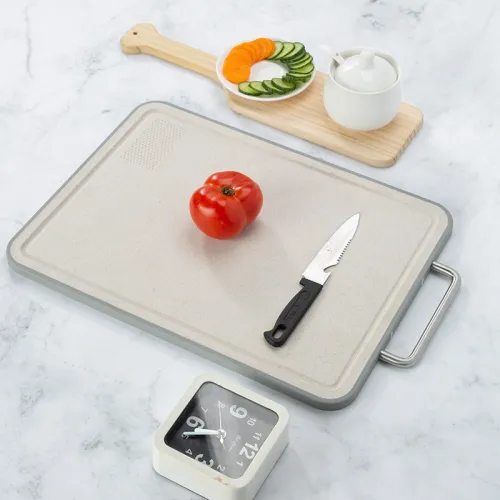 Steel and wheat strawSUS 304 Double-Sided Board40 x 28 x 1.1 cm. 304 steel face for raw protein, wheat-straw PP face for produce. Embossed non-slip back, stainless carry handle, dishwasher safe.View specs →
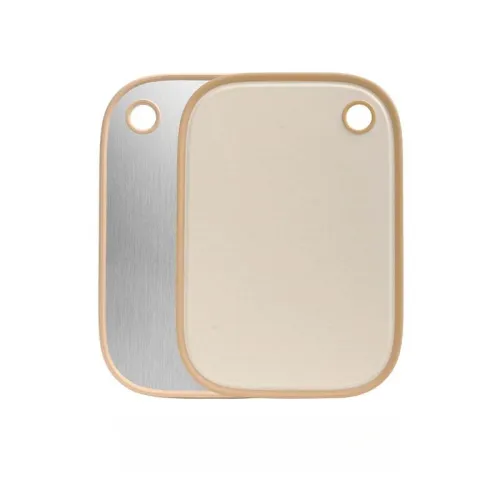 Four colourwaysColour-Coded Steel and PP Board40 x 28 x 1.2 cm. Green, pink, yellow or grey, so raw and cooked are separated by colour as well as by face. Corner hanging hole for vertical storage.View specs →
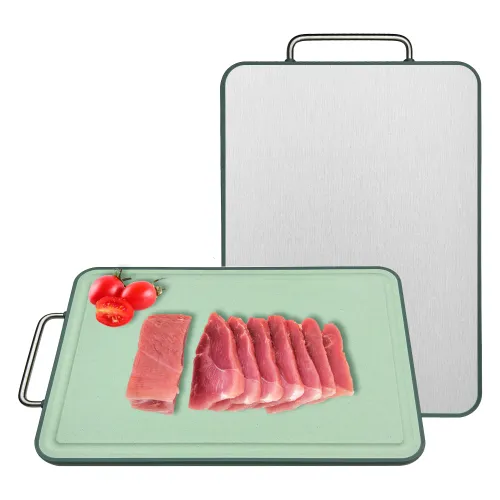 Heavy buildBoard with Solid Steel Handle40 x 28 x 2.4 cm. Full wrap-around non-slip edge, invisible spill-proof groove, solid stainless handle. The one to take a cleaver.View specs →
Frequently Asked Questions
Are stainless steel cutting boards safe?
Yes, provided the steel is genuinely food-grade 304 or 316. Food-grade stainless is non-reactive, so acid, salt and spice do not affect it, and it does not leach anything into food. Its non-porous surface means bacteria sit on top where cleaning reaches them. The usual caveats still apply: wash between raw and ready-to-eat foods, and dry the board rather than leaving it wet.
Are they safe for knives, or do they ruin them?
They are safe to use and hard on edges. A knife will not be damaged beyond repair by a steel board, but it will need honing and sharpening more often than it would on wood or soft plastic. The wear comes from impact rather than from the board being harder than the blade, which it typically is not.
Do they dull knives permanently?
No. Dulling is a maintenance interval, not a material change. Honing realigns a rolled edge, and sharpening restores an apex that has micro-chipped. What changes is how often you have to do it. If you cut on steel daily with a thin, high-hardness blade, expect that interval to shorten noticeably.
Are stainless steel cutting boards dishwasher safe?
Solid steel is completely unaffected by a dishwasher. For a steel and polymer composite, the answer depends on how the two faces are joined, so ask the maker whether the steel is moulded into the body or glued to it. Moulded construction handles hot cycles for years. Rinse heavy debris first and load the board so nothing can strike it during the cycle.
Do they rust or stain?
Quality 304 or 316 will not rust in normal kitchen use. Spots appear when the board stays wet for long periods, when it is cleaned with steel wool or a chlorinated cleaner, or when the steel was never properly food-grade. Bicarbonate of soda paste handles light spotting, white vinegar handles hard-water film, and if the spots keep coming back the grade is the problem.
Do they scratch?
Yes, and it is cosmetic. Every knife contact leaves a fine mark on the finish. A brushed surface hides them for months; a mirror polish shows them within weeks. Neither affects hygiene, because a scratch in steel is still non-porous. This is the main reason to choose brushed over polished for a board you intend to actually use.
Is a stainless board better than wood?
For raw meat, fish and hygiene, yes. For knife life, feel and quiet, no. Wood yields under the edge and is far kinder to a thin blade; steel gives nothing and takes more frequent honing. Most kitchens get the best result from both, allocated to the jobs each does best.
Stainless steel or glass?
Steel, comfortably. Glass is unyielding, brittle, loud and the worst of the common surfaces for an edge, and its only real advantage is a completely non-porous surface, which steel also has. Glass belongs under a cheese board, not under a knife.
Can you cut raw meat on a stainless steel board?
It is the best material for it. Nothing soaks in, so a wash and a sanitiser brings the surface back to clean in under a minute. Keep it as your dedicated raw-protein board rather than flipping it, and if you do flip to the polymer face for vegetables, wash the board first.
Are stainless steel cutting boards antibacterial?
No, not in the technical sense, and any listing that says so is overstating. Steel is non-porous, which makes it easy to clean and sanitise completely, and that is a genuine hygiene advantage. The word "antibacterial" belongs to surfaces with a tested active additive. On our boards that additive is in the wheat-straw polymer face, not in the steel.
If you want pricing, a sample, or a specification sheet for any of the boards above, write to sales@chopaid.com or use the inquiry form below.